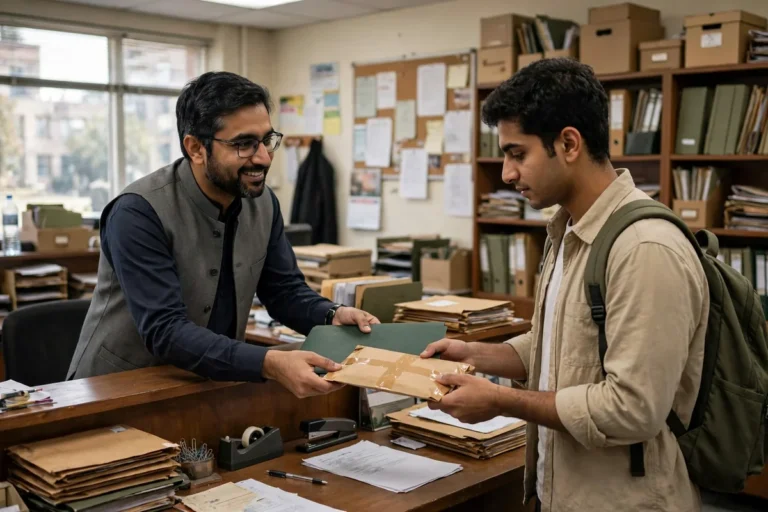

For most students, identity documents arrive in stages, and each stage unlocks the next thing: school admission, a bank account, a passport, a SIM in your own name, and eventually a job application. The sequence in Pakistan runs from birth registration, to the Child Registration Certificate — the B-Form — to a Juvenile Card if you want a photo card before 18, and then to the CNIC when you turn 18. Mixing up those stages is the most common reason for a wasted trip to a NADRA centre, so it is worth getting the order straight before you go.
The three documents, and who each one is for
| Document | Age | What it looks like | Main use for a student |
|---|---|---|---|
| B-Form (Child Registration Certificate, CRC) | Under 18 | Paper certificate, no wallet card | Proof of registration in NADRA’s record; needed for school, passport files, and as the basis for a first CNIC |
| Juvenile Card | Under 18 | Wallet-size smart card with photo and chip | Photo ID a child can carry — for school, exams, travel documentation, and bank accounts where a card is asked for |
| CNIC | 18 and over | Wallet-size card with photo and chip | The adult identity card: bank accounts, SIM registration, passport, jobs, and voting-age records all run through it |
The B-Form and the Juvenile Card cover the same age group, but they are not the same document. The B-Form is the registration record itself. The Juvenile Card is a photo smart card built on that record. You do not need a Juvenile Card to get a CNIC later, but you do need to be registered — through a B-Form — before NADRA can issue an adult card.
Under 18: B-Form first, Juvenile Card if you need a photo card
Birth registration with the Union Council comes first. A parent applies for the child’s registration, and NADRA issues the Child Registration Certificate from that record. For a very young child, the B-Form alone is usually enough for school admission. The Juvenile Card becomes useful when an institution or a process specifically asks for a photo ID card, or when parents want the child to carry identification that is harder to damage or lose than a paper certificate.
Biometrics depend on age. Very young children are generally registered without fingerprints; a photograph and, in the older-child brackets, iris capture and then fingerprints come in as the child grows. NADRA staff at the centre apply the bracket for the child’s actual age, so there is no need to guess which captures apply — but the child must attend in person for a Juvenile Card, and a parent or guardian must attend too, with their own CNIC.
What to take for a B-Form or Juvenile Card
- The parent or guardian’s original CNIC.
- The child’s Union Council birth certificate or computerized birth record.
- The child’s existing B-Form, if one has already been issued and you are applying for a Juvenile Card.
- For children aged 10 and above, a school certificate is sometimes asked for — carry one if you have it.
- Originals plus photocopies. NADRA works from originals, and a missing original is the quickest reason for a return visit.
One detail worth checking at home: the child’s name and date of birth must match across the birth certificate, the school record, and NADRA’s family record. A mismatch discovered at the counter usually means correcting the source record first, not arguing at the NADRA desk.
Turning 18: applying for your first CNIC
At 18, a Pakistani citizen becomes eligible for a regular CNIC, and the Juvenile Card or B-Form stops being the right document. The first CNIC is the one application students most often delay — and then discover they need urgently for a bank account, a scholarship form, or an admission that asks for a CNIC number rather than a B-Form number.
What to take
- Your original B-Form (Child Registration Certificate) or birth certificate.
- A parent’s CNIC copy — father or mother — and, where NADRA asks, a family member present for biometric verification. An adult sibling can in some cases provide family verification, but NADRA confirms eligibility case by case, so do not rely on a sibling attending instead of a parent without checking.
- Proof of residence if asked for, such as a utility bill or domicile. Not every first-CNIC case is asked for this, but carrying it avoids a second trip.
- Yourself, in person. Fingerprints, photograph, and signature are captured at the centre, and nobody can complete that part on your behalf.
What happens at the centre
- Take a token for the CNIC application and have your documents checked.
- Your photograph and fingerprints are captured, and your data is entered from your family record.
- A family member’s biometric verification is completed where required.
- You choose the processing category, pay if that category carries a fee, and receive a tracking slip.
- Track the application with the tracking ID through NADRA’s website or the Pak-ID app, and collect or receive the card as per the service you chose.
If your family record is incomplete — for example, a parent’s record was never updated after a marriage or a name change — sort that out first. A first CNIC built on an incorrect family tree creates problems for every document that follows it, from passports to family registration certificates.
Fees: what to check before you pay
Fees are the part of this topic where online figures disagree most, so read this section as a warning rather than a price list. NADRA revises its fee schedule from time to time, and different card types — ordinary CNIC, Smart CNIC, Juvenile Card, and B-Form — are priced differently.
Two points are consistently reported across recent fee summaries: a first ordinary CNIC on normal processing is reported as free, while faster urgent and executive processing for CNIC services carries a charge; and a B-Form (CRC) on normal processing is reported at a small fee, around Rs. 50, with a higher executive fee for one-day service. For the Juvenile Card, published figures conflict — some guides quote the Smart NIC scale, while a recent check of NADRA’s own fee page found no separate Juvenile Card line at all. That conflict is exactly why this guide does not print a single Juvenile Card price as fact.
Before you pay anything, check the amount shown in the Pak-ID app or on NADRA’s official fee schedule, and confirm it again at the counter. If a fee quoted to you does not match NADRA’s published schedule, ask where it is written before handing over money. NADRA’s helpline is 1777, and its official site is nadra.gov.pk — use those channels rather than a social media post for a fee figure.
Common problems, and how to avoid them
- Waiting until an admission deadline. Normal processing takes weeks, not days. If a university form asks for a CNIC number, start the application the month you turn 18, not the week the form closes.
- An expired or un-updated parent CNIC. NADRA verifies against the parent’s current record. An expired parent CNIC or an unrecorded change in marital status can hold up a child’s application.
- Losing the tracking slip. Without the tracking ID, following up is much harder. Photograph the slip as soon as you receive it.
- Assuming a Juvenile Card works as travel ID. It does not replace a passport for international travel. It supports identity verification within Pakistan and during a passport application; the passport itself is still required to travel.
- Using the wrong card after 18. Once you hold a CNIC, present the CNIC, not the Juvenile Card or B-Form, where an adult identity document is asked for.
Frequently asked questions
Do I need a Juvenile Card before I can get a CNIC at 18?
No. What you need is registration in NADRA’s record, which the B-Form represents. A Juvenile Card is an optional photo card for under-18s, not a prerequisite for a CNIC.
Can I apply for my first CNIC online?
First-time registration generally requires an in-person visit for biometrics and family verification. Renewals, duplicates, and some other CNIC services can be handled through the Pak-ID app, but do not assume a first CNIC can be completed entirely from home — check NADRA’s current guidance for first-time applicants.
What if my parents have passed away?
Eligible applicants can still obtain a CNIC. NADRA assesses the existing family record and whether alternative verification is permitted, so visit a centre with whatever family documents you hold rather than assuming you are ineligible.
What should I do if my card is lost?
Report it and apply for a duplicate at a NADRA centre with a parent’s CNIC where required, fresh biometrics, and the duplicate fee shown on NADRA’s schedule. For a lost Juvenile Card, a parent should attend with the child, and a police report is commonly advised to reduce misuse risk.
Note: YouthSchemes.com is an independent information site, not NADRA. Fees and processing times change, so confirm the current figure on NADRA’s official fee schedule before you apply.
If you are sorting out documents for admission, our guide to university admission in Pakistan covers the wider checklist, and students choosing a degree should read about how to choose a BS programme after Intermediate.