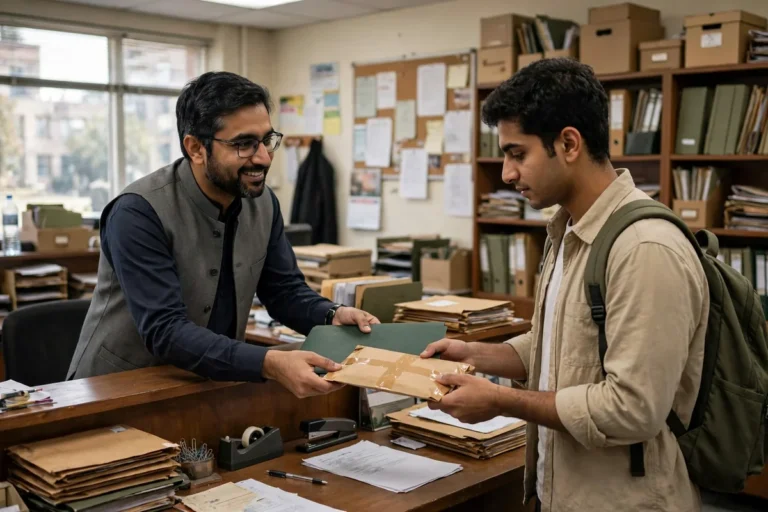

If you have done O Levels or A Levels and want to study at a Pakistani university, you will keep meeting one phrase on admission forms: IBCC equivalence. It is not an extra exam, and it is not a remark of your papers. It is the official conversion of your Cambridge or other international qualification into the Pakistani system, so that a university can compare your grades with those of a Matric or Intermediate student on the same scale. Without it, most local institutions simply cannot place you on a merit list.
The body that issues it is the Inter Board Committee of Chairmen, usually shortened to IBCC. This guide explains what equivalence converts to, which documents you need, how the marks are broadly worked out, and where students most often go wrong — without pretending that a single online calculator can replace the certificate IBCC itself issues.
What equivalence actually converts
An O Level qualification is converted to the equivalent of Matric (SSC) in Pakistan. An A Level qualification, taken together with your O Levels, is converted to the equivalent of Intermediate (HSSC), expressed out of 1100 marks — the same total used for the local Intermediate examination. That is why A Level equivalence is not calculated from your three A Level subjects alone: IBCC combines your O Level and A Level results to reach the HSSC figure, and it will not normally process A Level equivalence until your O Level equivalence has been issued.
Equivalence is different from attestation, and the two are often confused. Equivalence converts your qualification into Pakistani marks. Attestation verifies a document for use, typically abroad. If you need your certificates for overseas use, you may need attestation as a separate step after equivalence — but for admission inside Pakistan, it is the equivalence certificate that universities ask for.
When you need it
- University admission in Pakistan. Public and many private universities ask for the equivalence certificate, or at least the equivalence marks, with the application.
- Professional entry tests and programmes. Where a minimum Intermediate-equivalent score is a condition, the IBCC figure is the number that is checked.
- Scholarships and government applications. Any scheme that compares applicants across education systems needs a common scale, and IBCC equivalence provides it.
Start early. Equivalence involves verification with your examination board, so it is not an overnight document even when the online steps look quick. If your university’s admission window is short, apply for equivalence as soon as your final results are available — or, where the rules allow, as soon as the statement of results can be submitted — rather than waiting for the prospectus to remind you.
Documents you will need
IBCC asks for originals, not just scans, for the core documents. The usual set is:
- Your original O Level and, where applicable, A Level certificates — or, within its validity window, the original statement of results. A statement of results is generally treated as valid for about six months from issue; after that, the original certificate is required.
- Photocopies of those certificates.
- Your CNIC or B-Form, and a parent or guardian’s CNIC copy.
- Your O Level equivalence certificate, when you are applying for A Level equivalence.
- Passport copies, where applicable — particularly if part of your schooling was abroad, or if your case involves foreign-national or overseas-candidate rules.
- Passport-size photographs, if the application form for your category asks for them.
- Any school verification letter or online result code IBCC or your board requires for verification.
Keep a complete photocopy set for yourself before you submit anything, and check that the name on your certificates matches your CNIC or B-Form exactly. A name variation between a Cambridge certificate and a NADRA record is a common cause of queries, and it is far easier to explain with supporting records at submission than after a verification query arrives.
How marks are worked out — in broad terms
IBCC converts each grade to a mark, adds the marks for the subjects that count, and expresses the result on the Pakistani scale. For the familiar letter grades, the commonly published conversions are A = 85, B = 75, C = 65, D = 55, and E = 45. The top grade, A*, is handled differently: IBCC sets its value subject by subject each session, and its own worked example shows A* values of 93 to 95 depending on the subject — for instance, 95 for Mathematics and 93 or 94 for several other subjects in that example. Numeric O Level grades are also accepted, with 9 corresponding to A* and lower numbers stepping down from there.
Which subjects count is where students make the most expensive mistakes. For Pakistani-national students, the compulsory O Level subjects — English, Urdu, Islamiyat, and Pakistan Studies — form part of the calculation, along with the core subjects of your group. For foreign nationals and overseas candidates, fewer O Level subjects are counted and the total is scaled differently to reach the same 1100 scale. IBCC also updates its subject-counting rules from time to time, including a distinction between students who finished O Levels in recent sessions and those who finished earlier. That is why this guide gives the broad approach rather than a fixed formula: the exact subject set and the current session’s A* values are the two things you must confirm on IBCC’s own material for your session before you estimate your marks.
IBCC publishes a worked example of an A Level calculation on its own site, showing how O Level and A Level marks combine into a total out of 1100. Reading that example with your own grades in hand is the most reliable way to understand the method — far more reliable than a third-party calculator that does not state which session’s rules it is using. You can find it here: IBCC’s example for calculating A Level equivalence marks. Treat any calculator result as an estimate only; the figure on your issued certificate is the one universities will use.
How to apply, step by step
- Register on IBCC’s portal. Create an account on IBCC’s official site, ibcc.edu.pk, using your name, email, and CNIC or B-Form details.
- Choose the equivalence application and your qualification type. Select O Level, A Level, or the relevant foreign qualification, and enter your subjects, grades, session, and board exactly as they appear on your certificates.
- Upload scanned copies of your documents. Scan clearly — a blurred certificate scan is a common reason for a query. Keep the originals ready, because submission of originals is part of the process for most categories.
- Pay the fee shown in the portal. The fee depends on your category — for example, whether your examinations were taken in Pakistan or abroad — and IBCC revises its fee schedule, so use the figure the portal shows for your application rather than a figure quoted in an old guide. Keep the payment receipt or challan.
- Submit and note your tracking number. You should receive confirmation by email or SMS. Save the reference number; it is how you follow up.
- Wait for verification. IBCC verifies your qualification with the relevant board. If a document is missing or unclear, IBCC contacts you — respond promptly, because verification waits for you, not the other way round.
- Collect or receive the certificate. Depending on the option you selected, you collect the certificate from an IBCC regional office — Islamabad, Karachi, Lahore, Peshawar, and Quetta are among the offices that handle submissions — or receive it by courier.
Processing commonly takes one to a few weeks once verification is complete, but board verification can extend that. If you have a university deadline, say so when you apply and ask what urgent options, if any, are available for your office and category — do not assume an urgent service exists for every case.
Mistakes that cost students a merit-list place
- Applying for A Level equivalence without O Level equivalence. The HSSC figure is built from both. Get the O Level certificate first.
- Leaving out a compulsory subject. Urdu, Islamiyat, and Pakistan Studies at O Level are not optional extras for Pakistani-national students. A student who studied abroad for part of their schooling should check the compulsory-subject requirement for their exact case before applying.
- Using an old formula. A* values and subject-counting rules are set session by session. A calculator or guide from two years ago may use values IBCC no longer applies.
- Submitting a statement of results that has expired. If more than about six months have passed since the statement was issued, submit the original certificate instead.
- Confusing equivalence with attestation. An attested O Level certificate without an equivalence certificate does not give a university your marks out of 1100.
Frequently asked questions
Do I need equivalence if I am applying abroad?
Generally no — foreign universities assess your Cambridge grades directly. Equivalence is for the Pakistani system: local universities, local professional programmes, and government or scholarship processes that require a Pakistani-equivalent score.
Can I estimate my marks before applying?
Yes, as an estimate. Convert your grades using the published grade-to-mark values, include the compulsory subjects that apply to your category, and compare your method against IBCC’s own worked example. Do not enter an estimated figure on an admission form as if it were your official equivalence — enter the official figure once the certificate is issued, or mark it as awaited where the form allows.
What if I am short of a compulsory subject?
Ask IBCC directly about your case before you submit. Subject deficiencies are handled case by case, and the correct remedy — an additional paper, a different category, or a revised application — depends on which subject is missing and where you studied.
Is equivalence a one-time document?
The certificate stands unless you need a revision — for example, after a recheck changes a grade — or a duplicate after loss. Revisions and duplicates have their own applications and fees, so keep the original certificate safe once it arrives.
Note: YouthSchemes.com is an independent information site, not IBCC. Subject rules, A* values, and fees are set by IBCC session by session, so confirm the current rules on IBCC’s official site before you apply.
Once your equivalence is in hand, the next step is usually the application itself — see our step-by-step guide to university admission in Pakistan, and confirm your chosen institution’s standing by learning how to check if a university is HEC-recognised.