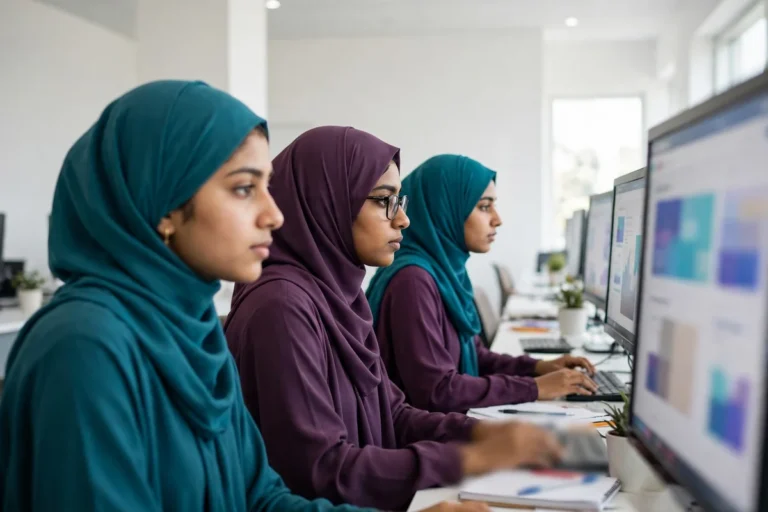

Pakistan’s outsourcing industry runs on people who can handle a customer well on a call, in a chat window, or over email — and it pays for that skill in a way many entry-level jobs do not. PSDF’s Global Rozgar programme, officially the Chief Minister’s Youth Employability Program for BPOs, is built around exactly that gap. It is a demand-driven, employer-led initiative run by the Punjab Skills Development Fund (PSDF) to prepare young people for customer support, digital services and IT-enabled operations, with training delivered by the BPO employers themselves.
That employer involvement is the point of the programme, and also the reason to read its promises carefully. BPOs screen the candidates, BPOs deliver the training, and the programme then talks about placement with participating BPOs. This guide separates what PSDF’s own page actually states from what blogs have added around it.
Table of Contents

Who can apply
PSDF’s eligibility criteria on its Global Rozgar page are short:
- Location: Punjab domiciled candidates.
- Age: 16–35 years.
- Education: minimum Matriculation or equivalent.
- English: functional English communication.
- Computer skills: basic computer literacy, as per employer requirement.
The page also names, among its target beneficiaries, youth under Child Protection, women from marginalised groups, and youth with special needs. It does not turn those groups into a separate application route on the page, so do not let any agent sell you a special quota entry — the published criteria above are the ones to check yourself against.
Notice what is not here: there is no requirement for a degree, and no requirement for previous call-centre experience. What matters, in the programme’s own design, is whether you can communicate in English, use a computer, and pass an employer’s screening. If your spoken English is weak, that is the honest place to start working before you apply, because the selection process tests communication directly.
What the training covers
Training is practical and job-focused rather than academic. PSDF groups it into core BPO skills, technical and digital skills, and soft skills:
- Core BPO skills: customer support across voice, chat and email; sales communication and client engagement.
- Technical and digital skills: communication and basic writing, digital skills and AI, language skills, customer relationship management (CRM), medical billing, and call and chat handling.
- Soft skills: English speaking and business communication, digital professionalism and remote work etiquette, and emotional intelligence and problem solving.
Medical billing deserves a note, because it surprises many applicants. It is back-office work for healthcare billing systems — detailed, process-driven, and quite different from handling customer calls. If you prefer structured computer work to live conversation, it is worth asking, at screening, which track an employer is actually hiring for, rather than assuming every seat leads to the same job.
How the programme works
PSDF lays out five steps, and the order matters:
- Industry-led mobilisation and screening: candidates are sourced and screened by BPO employers.
- Pre-assessment and interviews: communication, digital skills and aptitude testing.
- Training delivery: practical, job-focused training delivered by BPOs.
- Assessment and certification: end-of-training evaluations aligned with job roles, leading to industry self-certification or certification by accredited certification bodies.
- Guaranteed job placement: employment with participating BPOs.
The page also states that only shortlisted candidates will be contacted. That is normal for an employer-led programme, but it means silence after applying is not necessarily a rejection you can appeal — it may simply mean you were not shortlisted in that round. Keep a copy of whatever you submit, and do not pay anyone who claims they can move your application up the list.
The placement and salary claims — read as programme claims
Under “Employment Outcomes”, PSDF’s page states guaranteed placement for successful trainees, an average expected salary of PKR 45,000–100,000 per month, opportunities in local and export-oriented BPO operations, and career progression in IT-enabled services.
Those figures are the programme’s own claims, not verified outcomes, and this guide reports them that way on purpose. A range that wide already tells you the real story: pay in BPO work varies a great deal by role, shift, language requirement and employer. A night-shift voice role for an international client and a daytime chat-support role are not the same job, and no programme page can promise you the top of the range. Treat “guaranteed placement” the same way — the page ties it to successful trainees, which means completing training and passing the end-of-training evaluation still comes first.
For a different PSDF route aimed specifically at rural women, see our guide to PSDF Mein Digital training for rural women. And if anyone asks you for a fee to secure a Global Rozgar seat, check the warning signs in our guide to fake government scheme websites and scams before paying anything.
What the official page does not say
This is where most third-party articles go wrong, so it is worth being explicit. On PSDF’s official Global Rozgar page, no fee, no training duration and no application deadline is stated. That means this guide does not describe the programme as free, and does not give a one-month duration or a last date — both figures circulate on blogs, but neither is on the official page. The page presents a “Join Now” submission form rather than a dated admission window, so the safe move is to apply through PSDF’s own page and confirm fee and duration details from PSDF directly if they matter to your decision.
For questions about the programme itself, PSDF lists its helpline as 0800-HUNAR (48627) and +92 42 35752190, with email Info@psdf.org.pk. Use those channels rather than a WhatsApp number posted on a blog.
Frequently asked questions
Who is eligible for PSDF Global Rozgar?
Punjab domiciled candidates aged 16–35, with at least Matriculation or equivalent, functional English communication and basic computer literacy as required by the employer.
Does Global Rozgar guarantee a job?
PSDF’s page states guaranteed placement for successful trainees, with employment at participating BPOs. That is the programme’s claim, tied to completing training and passing assessment — it is not a promise made before screening, and this guide does not present it as a verified outcome.
What salary does the programme claim?
PSDF states an average expected salary of PKR 45,000–100,000 per month. That is a programme claim, not a verified average, and actual pay will vary by role, shift and employer.
Is Global Rozgar free, and how long does it last?
PSDF’s page does not state a fee or a duration, so neither is claimed here. Confirm both with PSDF before relying on a blog figure.
Is there a last date to apply?
No deadline is shown on PSDF’s Global Rozgar page. The page offers a submission form and says only shortlisted candidates will be contacted, so apply through the official page rather than trusting a third-party deadline.
BPO work rewards a specific combination — clear English, patience under pressure, and comfort with systems and shifts — more than it rewards a degree. If that sounds like you, Global Rozgar is worth a serious look, but go in with the official page open and the programme’s claims read as claims. This guide is written independently of PSDF; for the final word on eligibility and openings, use PSDF’s own Global Rozgar page.