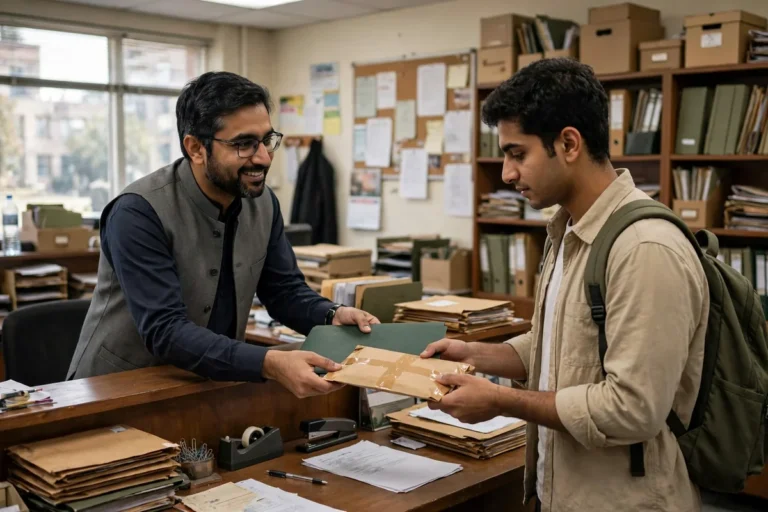

Changing institution mid-stream is common — a family moves city, a college does not offer your chosen group, or you have finished inter with one board and are enrolling at a university that wants proof you have left that board properly. What trips students up is not the move itself but the paperwork: the document that releases your record from one institution or board and lets the next one enrol you. Get that document wrong, or skip it, and the new institution may refuse admission even though your marks are perfectly good.

Migration certificate and NOC are related, not identical
In board usage, the two terms overlap and are often used for the same journey, but it helps to keep them distinct. A migration certificate is the document that records your move from one institution or board to another. A No Objection Certificate (NOC) is the permission from your current board that it has no objection to your leaving — the clearance the receiving board or university asks to see. BISE Lahore lists “NOC / Migration” as a single E-Service — applying for an NOC or for migration between different boards — which tells you how closely boards themselves treat them. In practice, apply for the service your receiving institution names: if it asks for an NOC, get the NOC; if it asks for a migration certificate, get that. Do not assume one document automatically satisfies a request for the other.
The four kinds of move
- School to school. Moving between schools, usually within the same board’s jurisdiction, for example after a family relocation.
- College to college. Moving between colleges at intermediate level, often because of a change of group, city or institution.
- Board to board. Moving from one board’s jurisdiction to another’s — for example, from Lahore to Multan, or from a Punjab board to a board in another province.
- Board to university. Leaving the board system for higher education, where the university or its admission office asks for migration or NOC documentation as part of enrolment.
The first two are the simplest, the third is the one most often delayed, and the fourth is the one most often discovered too late — at the university admission desk rather than before it. Whichever move you are making, start the paperwork before the receiving institution’s admission deadline, not on it.
Two different routes, depending on where you are going
Moves within the same board generally run through the institutions themselves. The usual instrument is Form 8, signed by the heads of both the leaving and the receiving institution, which records that both sides agree to the transfer. Because both institutions answer to the same board, no inter-board clearance is involved, and the process is largely a matter of both heads signing and the board’s record being updated.
For a BISE Lahore in-board move, Form 8 states a migration certificate is issued only until the triple-fee date in the board’s admission schedule for that exam — after that date the board will not issue it for that session, and that date changes every session, so check the current admission schedule before you start. Other boards set their own cut-offs.
Moves out of a board — to another board, or onward to a university that requires it — go through the board’s online NOC route instead. On the Punjab e-services pattern, you open your board’s e-services portal, choose the NOC/migration service, enter your examination and institution details, and generate a challan for the prescribed fee. BISE Lahore’s homepage confirms the NOC/migration service as a live E-Service on its portal. The receiving institution’s requirements decide which route you need, so confirm with them in writing — a message from an admission office beats a friend’s advice — before you choose.
The fee: why this guide gives no figure
Reported migration and NOC fees vary wildly — Rs. 1,900, Rs. 2,500, Rs. 3,000, Rs. 4,000 and Rs. 4,800 have all appeared across sources for different boards and move types — and no live portal challan figure was visible at the time of writing, since the portals generate the challan inside an application. That spread is itself the warning: there is no single migration fee, and a figure quoted for one board and one move type tells you nothing about yours. Pay only the figure your own board’s portal prints on your challan for your move, and keep the paid challan with your application record. If anyone quotes you a “standard” migration fee, ask them which board and which move type it is standard for — the answer will usually reveal the guess.
Mistakes that delay a move
- Applying to the wrong board. The NOC comes from the board you are leaving, not the one you are joining. Apply at the source.
- Missing a signature. On an in-board move, both heads must sign. A form signed by only one side is an incomplete application, however urgent your deadline.
- Leaving it to admission week. The receiving institution cannot enrol you on a promised NOC. Build in time for the board to process the request and for the document to reach you.
- Confusing migration with a duplicate or a correction. A migration certificate moves your record; it does not replace a lost certificate or correct a wrong name. Those are separate services with separate forms — see our guides to duplicate result cards and certificates and to name and date-of-birth corrections if either of those is what you actually need.
Frequently asked questions
Do I need an NOC to change college within the same board?
Usually not in the inter-board sense — in-board moves run through the institutions, typically via a form signed by both heads. Confirm with both institutions, since the receiving college’s own rules still apply.
Who issues my migration certificate?
Your current board, through its NOC/migration service, for moves out of that board. The receiving institution then records it as part of your admission.
Can I apply for migration online?
For out-of-board moves, yes, through your board’s e-services portal — BISE Lahore lists NOC/migration as a live E-Service. In-board moves still centre on the institutional form.
What if my new college admits me without an NOC?
Do not rely on it. Admission without the required migration paperwork can unravel later, when the board or university audits the enrolment. Get the document first.
A move is only finished when the paper trail is finished: the leaving side has released you, the board has recorded it where required, and the receiving side holds the document. Sort that chain early and the move itself becomes the easy part. This guide is independent of all boards; your leaving board’s portal and your receiving institution’s admission notice are the two documents that decide your case.