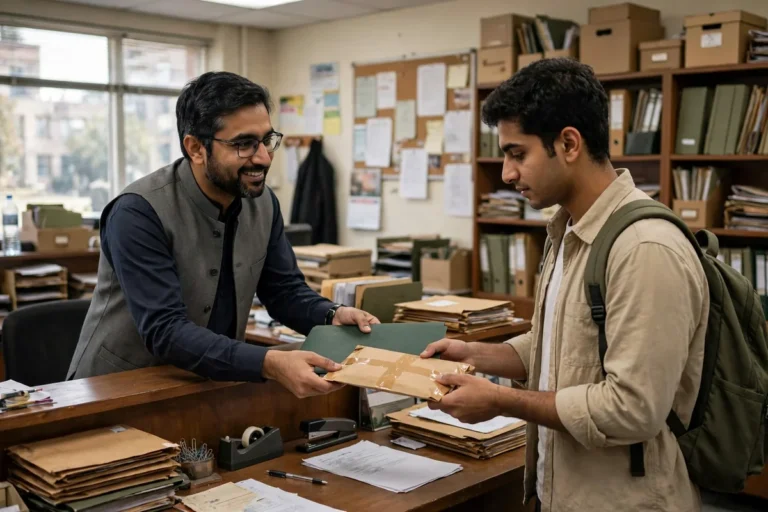

If your degree was issued by a Pakistani university and an employer, embassy or foreign university is asking for it to be attested, the first step in Pakistan is the Higher Education Commission — and that step no longer involves a trip to an HEC office. HEC has replaced its old walk-in and courier process with a fully online, paperless Degree Attestation System. You apply from your own account, upload scans, pay online, and download an e-attestation certificate once your university has verified your record.
The change matters because a great deal of older advice is still circulating: walk-in urgent counters, courier packets, photocopy attestation and fee tables from the old system. Under the current system, none of that applies. What follows is the process exactly as HEC’s own attestation page describes it, so you can ignore the outdated guides.

The four steps, in order
- Application by you. You create or sign in to your account on HEC’s e-services portal, choose “Degree Attestation”, enter your personal and degree details, upload your documents, and pay.
- Scrutiny by HEC. HEC checks your details against NADRA records, confirms all required documents are present, and checks that the information is consistent across your CNIC and your academic documents. If something is missing or inconsistent, the application is returned to your account with remarks, and you correct it and resubmit for re-scrutiny.
- Verification by your university. Once HEC is satisfied, your case goes to the university or degree-awarding institution that issued your documents, which verifies your credentials against its own records and sends its decision back to HEC.
- Issuance of the e-attestation certificate. After a final review, HEC issues the e-attestation certificate against the documents you applied for. You are notified by SMS and email, and you download the certificate from your online account.
You can track the real-time status of your application in your account, and HEC says applications can be submitted at any time, day or night, through the portal.
Before you start: get the details exactly right
The single most common reason for delay is a mismatch. HEC states plainly that your personal details on your CNIC and on all your educational documents must be identical — name, father’s name and date of birth included — and that if they are not, the attestation process will not be initiated. Check this before you pay anything, because the fee point below is unforgiving.
When you fill in the form, you will enter personal details (name, father’s name, date of birth, marital status, gender and address) and complete academic information for the documents you want attested: level of education, duration, degree title, campus or affiliated college, session, and registration, roll, seat or serial number, whichever applies. Select only the degree programme and the documents you actually need — the system calculates the fee from your selection, and you should only select documents that are required and readily available.
Which documents can be attested
- Degree
- Transcript — including a result card, result intimation card or detailed marks certificate
- Provisional certificate — only one issued by the university’s examination office
- HEC equivalence letter
Upload clear, legible scans of your CNIC (front and back) together with the documents above. Anything extra goes under the “Other Documents” tab. Two points from HEC’s guidelines are worth knowing in advance: transcripts can be attested even if the final degree has not yet been issued, provided the university clearly states the academic status for an incomplete transcript; and documents with overwriting, erasures or alterations will not be attested — you need a corrected, unaltered document from the awarding university first.
Fee and payment
The attestation fee is Rs. 3,000 per document — per degree, transcript, provisional certificate or HEC equivalence letter you select. A Consumer Number is generated automatically when you click “Proceed for Payment” in your account; you then pay through 1-Link (1-Bill) using your preferred online banking channel or platform, and click “Verify Payment”. Only once the payment is verified is your application automatically submitted to HEC.
Choose carefully: HEC states that in the case of an incorrect selection, the fee will neither be refunded, adjusted nor transferred. That is why the advice above — select only what you need, and check every detail before paying — is not boilerplate; it is the difference between a clean application and a lost fee.
What HEC will not attest
- Photocopies. Attestation of photocopies is no longer offered. Apply for the original documents.
- Foreign degrees. Degrees awarded by foreign universities are not attested by HEC. HEC issues equivalence letters against foreign qualifications, and only such equivalence letters are attested through the portal.
- Altered documents. Anything with overwriting, erasures or alterations is refused, as noted above.
- Fake or forged documents. HEC warns that submitting fake, forged or bogus documents will result in strict action under applicable laws and policies.
Two special cases deserve a mention. If your degree is in medicine or nursing, upload your professional registration card or certificate from the relevant council, such as PMDC or PNMC, under “Other Documents” when you apply. And for MS, MPhil or equivalent programmes launched after 7 November 2013, an HEC-issued NOC is mandatory. PhD applicants should also note that their name must appear in HEC’s PhD Country Directory.
Frequently asked questions
Do I need to visit an HEC office for attestation?
No. Under the current system there is no office visit and no hard-copy submission of originals. The whole application runs through HEC’s e-services portal.
How much does HEC attestation cost?
Rs. 3,000 per document, paid through 1-Link (1-Bill) after a Consumer Number is generated in your account. The fee is non-refundable, non-adjustable and non-transferable if you select the wrong document.
Can I attest a photocopy of my degree?
No. Photocopy attestation is no longer offered; apply for the original document.
Can HEC attest my foreign degree?
No. HEC does not attest foreign degrees. It issues an equivalence letter for a foreign qualification, and only that equivalence letter can be attested through the portal.
What happens if my CNIC details do not match my degree?
HEC will not initiate the process. Get the mismatch corrected on the relevant document first, then apply.
How long does attestation take?
HEC’s attestation page does not state a processing time, and this guide does not invent one. Your application passes through HEC scrutiny and then university verification, so the timeline depends on both — track the status in your portal account rather than relying on a timeframe quoted by a blog.
If your university record is clean and your documents match your CNIC, this is a straightforward online task — the work is in the preparation, not in queues or couriers. For help, HEC points applicants to its online help desk and its UAN, 111-119-432. And if you are still deciding where to study, our guide on how to check whether a university is HEC-recognised is worth reading before you enrol, since recognition is what makes attestation possible later. This page is written independently of HEC; the commission’s own portal is the final authority on your application.