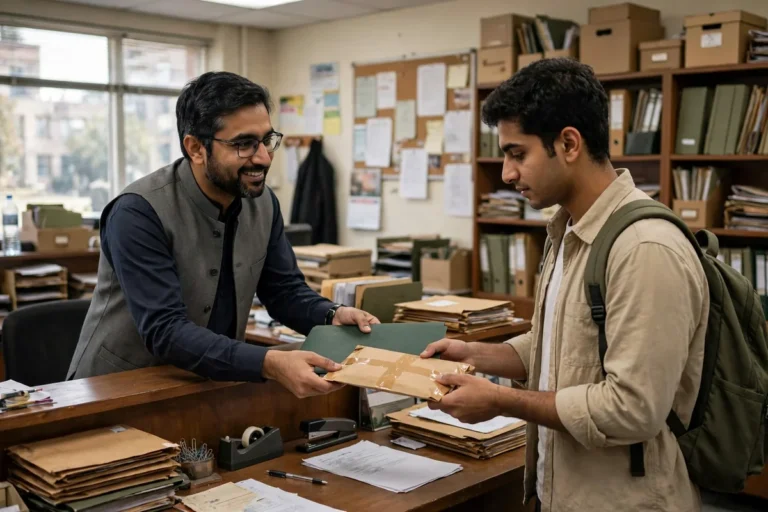

Admission week is the wrong time to discover a missing document. The form is open, the deadline is days away, and the one paper you need is at home, at your old school, or still being issued by your board. The list below exists to prevent that scramble: gather it now, in a single folder, and admission becomes a matter of filling in a form rather than chasing paper across the city.
One honesty note first: there is no single official admission checklist for Pakistan. Every college and university publishes its own notice, and those notices differ in detail. What follows is the core set that recurs across institution lists — the documents that come up again and again — assembled so you can prepare in advance. It is a checklist to prepare from, not a substitute for your target institution’s notice, and where the two disagree, the institution’s notice wins.
The core set to prepare
- Matric result card and certificate. Your SSC record — the foundation document for everything after it.
- Inter result card and certificate. Your HSSC record, where applicable. If you have just finished inter and the certificate has not been issued yet, the result card is what you will usually present first — confirm with the institution whether it will accept the result card pending the certificate.
- IBCC equivalence, for A-Levels students. If you studied under a foreign system such as A-Levels rather than a Pakistani board, institutions commonly ask for IBCC equivalence in place of the board certificates above. Arrange it early; equivalence is its own process and should not be left to admission week.
- Your CNIC or B-Form. Applicants under 18 commonly present a B-Form (Child Registration Certificate); applicants 18 and over present their CNIC. Whichever applies to you, make sure the name, father’s name and date of birth on it match your academic documents — a mismatch here is the same problem described in our guide to correcting a name or date of birth on a board certificate, and it is far easier to fix before admission than during it.
- Guardian’s CNIC. A copy of a parent’s or guardian’s CNIC is routinely asked for, both for identification and for fee and contact records.
- Passport-size photographs. Recent photographs, in the number and background the institution specifies. Keep a few extra; forms, cards and files each seem to need one more than you expected.
- Domicile or PRC, where a quota applies. If you are applying under a district, provincial or other quota, or the institution asks for proof of residence, a domicile certificate (or Provincial Residence Certificate, PRC, in Sindh) is part of the file. If no quota applies to your seat, the institution may not ask for it — but having it ready costs nothing.
- Character certificate. Usually issued by your last school or college, confirming your conduct as a student there. Request it before you leave the institution, while your record is fresh and the signatory is available.
- Migration certificate or NOC, if you are switching boards. If your previous board differs from the board or system your new institution falls under, the migration or NOC document covered in our guide to board migration certificates and NOCs belongs in the folder too.
- Entry-test card or result, where applicable. Programmes that require an entry test will ask for the test admit card, the result, or both. Keep both, even if the form only asks for one.
- Fee receipt. Once you pay any application or processing fee the institution charges, keep the receipt or transaction record with the file — it is your proof of payment if the portal record lags behind.
Originals, photocopies — and the verification moment
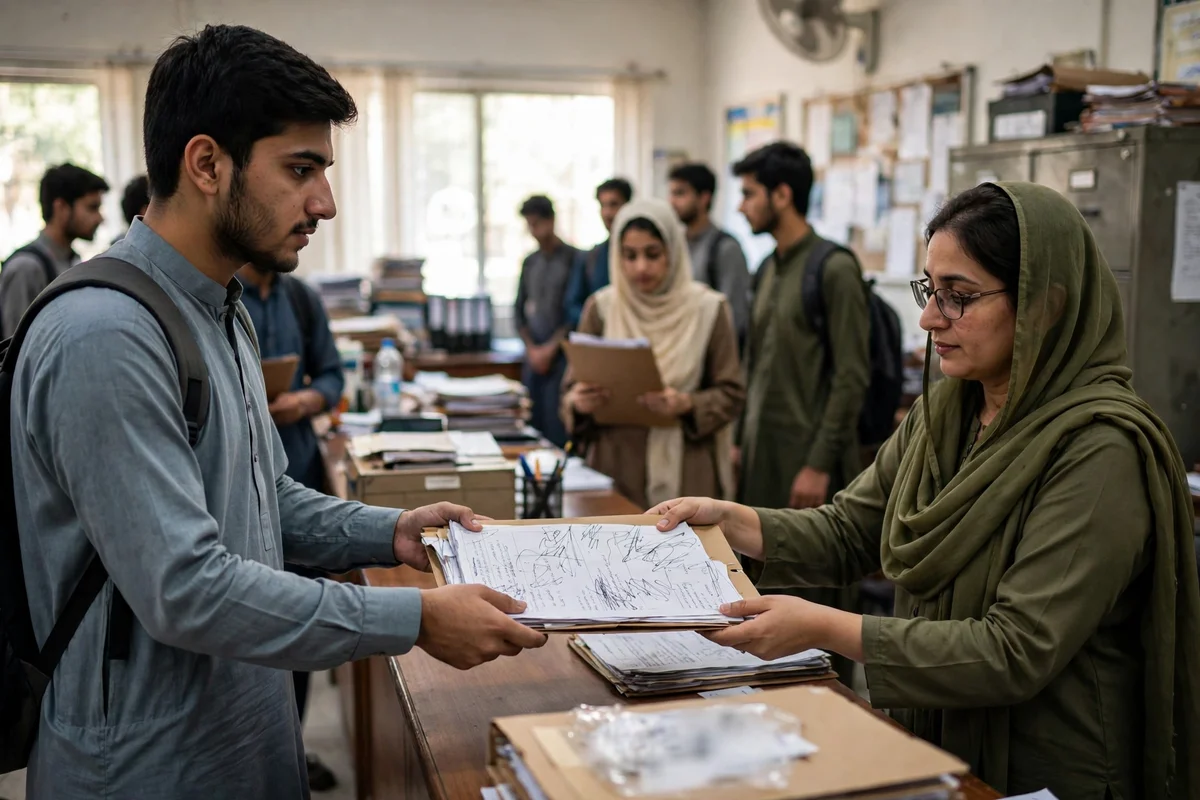
Prepare both. Institutions commonly ask for photocopies with the application and then verify the originals at enrolment: you present the original, they compare it with the copy, and they return the original to you. That verification step is why the folder matters in physical form, not just as phone photos. Keep originals in one envelope and a set of photocopies in another, and never hand over an original document without a receipt or an entry in the institution’s record — originals that vanish into an office drawer are a separate, avoidable problem.
Photocopies deserve the same care as originals: a faint, cropped or half-legible copy of a result card invites a query that a clean copy would not. Copy both sides where the reverse carries stamps, signatures or important notes, and check each copy against the original before you file it.
Three situations that need extra preparation
If your documents do not match each other. A name spelt one way on the result card and another on the CNIC, or a date of birth that differs between records, will surface at verification. Sort corrections before admission week wherever possible; the correction route is slower than the admission window.
If you are switching boards or systems. Add the migration/NOC document and, for foreign-system students, the IBCC equivalence to the core set, and confirm with the receiving institution that those are the documents it expects. Different receiving institutions phrase the requirement differently, and a document by the wrong name can be rejected even when it is the right document in substance.
If you are applying under a quota. Domicile, PRC and any quota-specific certificate should be ready before the form opens, because quota documents often depend on other offices and their own timelines. A quota seat lost to a missing domicile is lost to paperwork, not to merit.
What this checklist deliberately does not cover
This is a documents checklist only. It does not describe admission procedures, merit lists, merit formulas or fee structures — those belong to each institution’s own notice and to our step-by-step guide to university admission in Pakistan, step by step, which covers the process itself. If a detail here and a detail there seem to conflict, the institution’s notice and that process guide outrank this list: this page tells you what to gather, not how any particular institution will judge it.
Frequently asked questions
Do I need originals or photocopies for admission?
Both. Photocopies usually go with the application; originals are verified at enrolment and returned to you. Prepare a clean set of each.
What if my inter certificate has not been issued yet?
Present the inter result card first and confirm with the institution whether it accepts the result card pending the certificate, and by what date the certificate must follow.
Do A-Levels students need board certificates?
No — they present IBCC equivalence instead, where the institution requires it. Arrange equivalence early, since it is a separate process.
Is a domicile certificate always required?
No. It is required where a quota applies or the institution asks for proof of residence. If neither applies to your seat, the institution may not ask for it, but keeping it ready does no harm.
What overrides this checklist?
Your target institution’s own admission notice. It is the final word on what that institution requires, in what form, and by what date.
Gather the folder once, keep it complete, and admission season stops being a hunt for paper and becomes what it should be: a decision about where you want to study, made with the documents already in hand. This list was put together as an independent preparation aid, not as any institution’s official requirement — so use it to get ready, then let your chosen institution’s notice have the final say.